


3D Bioprinting Market Size To increase till 2032-IMR Study
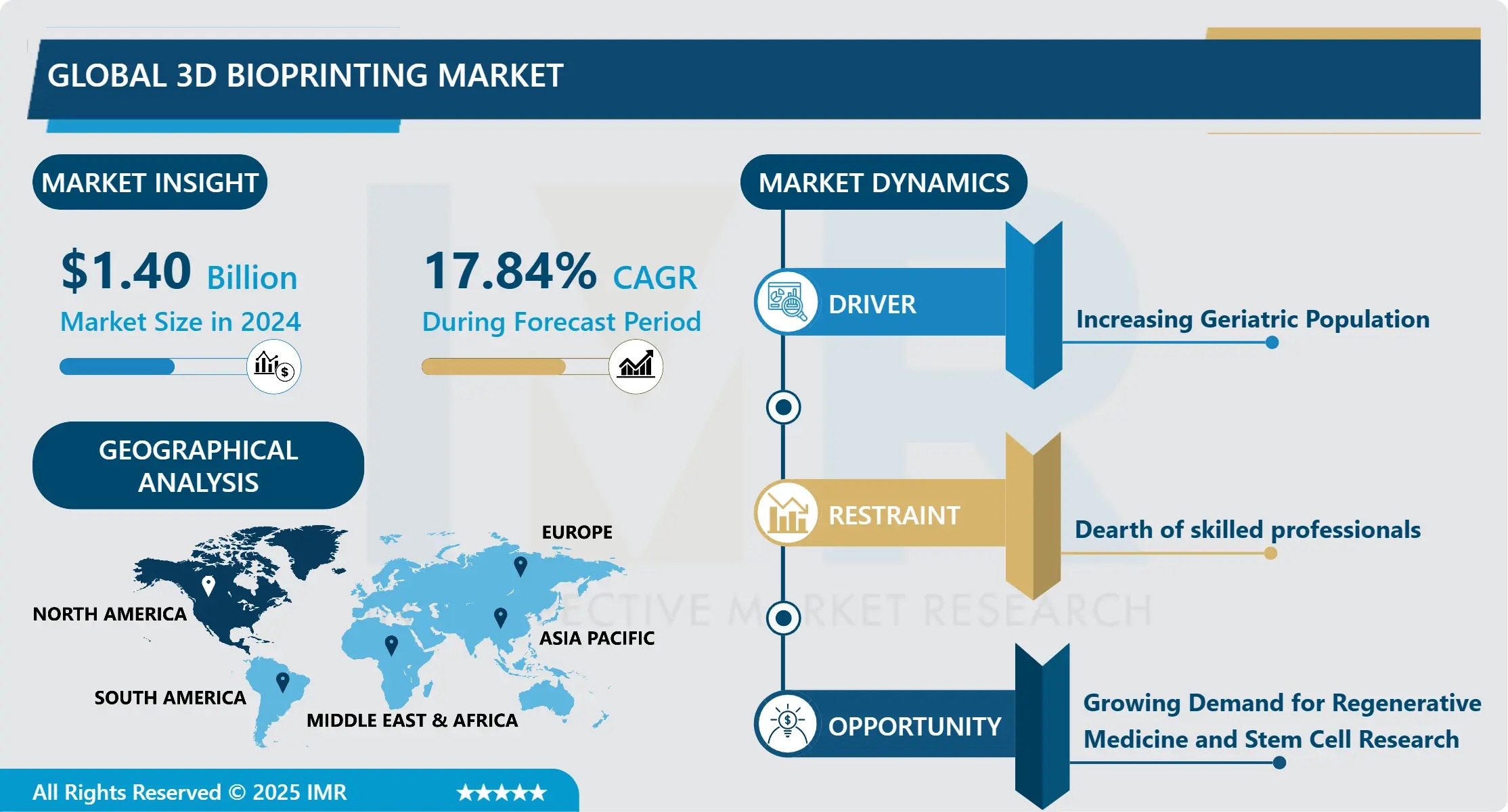
The Global 3D Bioprinting Market is undergoing a rapid, high-growth expansion, poised to fundamentally redefine healthcare and pharmaceutical research. This dramatic acceleration is fueled by increasing investments in regenerative medicine, the critical global need for organ and tissue substitutes, and the decisive shift away from traditional, less predictive 2D cell cultures. According to a new, authoritative report from Introspective Market Research (IMR), the market, valued at USD 1.40 Billion in 2024, is projected to soar to USD 6.14 Billion by 2032. This explosive growth trajectory is sustained by a robust Compound Annual Growth Rate (CAGR) of 17.84% over the forecast period (2025–2032).
3D bioprinting leverages advanced deposition and assembly systems—such as extrusion, inkjet, and laser techniques—to precisely place biomaterials (bioinks) and living cells, constructing intricate, three-dimensional functional tissues and organ prototypes. This technology promises to revolutionize areas ranging from toxicology screening and personalized drug development to complex tissue engineering for transplantation.
Quick Market Insights: Key Data Points
|
Metric |
Value |
|
Market Value (2024) |
USD 1.40 Billion |
|
Projected Value (2032) |
USD 6.14 Billion |
|
Forecast CAGR (2025-2032) |
17.84% |
|
Leading Technology Segment |
Syringe-based Bioprinting |
|
Dominant Application Segment |
Drug Testing |
|
Top Regional Leader |
North America |
|
Primary Market Driver |
Increasing Geriatric Population and Associated Disease Burden |
What Breakthroughs Are Unlocking the True Potential of Organ & Drug Testing?
The core opportunity propelling the 3D Bioprinting Market is its ability to create three-dimensional tissue models that accurately mimic the complex function and structure of human organs. This capability is critical for two major applications: Organ & Drug Testing and Toxicology Screening.
Traditionally, drug testing relied heavily on less predictive 2D cell cultures or animal models. 3D bioprinted tissues offer significantly enhanced accuracy for assessing the effects of pharmaceutical compounds. For instance, companies are offering bioprinted liver and kidney tissues for toxicity testing, drastically improving reliability and aligning with ethical concerns about reducing animal testing reliance.
Furthermore, this technology is vital for the future of personalized medicine. By utilizing a patient’s own cells in the bioink, researchers can create customized tissue models to study specific disease conditions and accurately predict how an individual might respond to a particular drug regimen. This high-throughput capability accelerates the identification of viable drug candidates with therapeutic efficacy and minimal side effects, thus radically reducing R&D costs and shortening drug discovery timelines.
Regional Leadership and Critical Segmentation Analysis
North America is expected to dominate the global market over the forecast period. The region's leadership is solidified by a confluence of factors: the presence of world-leading research institutions and biotechnology companies, substantial capital investment (including venture capital and government grants) in the healthcare sector, and a supportive regulatory environment (such as the FDA) that facilitates the swift commercialization of new bioprinting technologies. Strong collaborations between industry and academia further accelerate innovation translation.
The Asia Pacific region is anticipated to be a major growth engine, driven by rising healthcare spending, increasing governmental focus on domestic R&D capabilities, and the presence of emerging biotech hubs in countries like South Korea, China, and Japan.
Segmentation Highlights:
- By Application: The Drug Testing segment holds the largest share. This dominance stems from the technological advantage of 3D models offering a more reliable and ethically sound platform for high-throughput screening of drug candidates compared to traditional methods.
- By Technology: The Syringe-based segment is projected to dominate the market. Syringe-based bioprinting offers exceptional control over the precise deposition of bioink—the cell and biomaterial mixture—which is essential for creating intricate 3D structures. Its versatility in handling a wide range of bioinks and its scalability for producing larger tissue constructs make it preferred for both research and clinical projects.
- By End-Users: Research Organizations & Academic Institutes and Biopharmaceutical Companies are the largest consumers. Academic research is the bedrock of innovation, while biopharmaceutical companies drive commercial adoption for faster, cheaper, and more accurate drug discovery.
Cost Efficiency, Challenges, and Breakthrough Innovations
Despite the immense promise, the market faces key constraints, notably the dearth of highly skilled professionals capable of operating and maintaining these complex, specialized bioprinting systems. Furthermore, the high initial cost of bioprinting instruments and the regulatory complexity surrounding engineered tissues for transplantation represent significant hurdles.
How to Make 3D Bioprinting Cost-Efficient and Realize Maximum Benefits:
1. Reduced R&D Cost and Time: The most critical financial benefit is the reduction in drug discovery costs. By creating highly predictive 3D human tissue models, pharmaceutical companies can fail faster and earlier in the pipeline, eliminating costly late-stage clinical trials that often fail due to poor predictability.
2. Accelerated Organ Transplantation: While still nascent, the potential to bioprint functional organs (e.g., hearts, kidneys) using a patient's own cells promises to dramatically reduce the long and perilous wait times for transplants, significantly improving healthcare outcomes and reducing lifetime care costs.
3. Software and Material Standardization: Innovations in user-friendly software (like DNA Studio) and the standardization of high-quality bioinks are essential for making the technology more accessible, lowering the barrier to entry for research laboratories and smaller biotech firms.
Latest Breakthroughs from Key Companies:
Major market leaders, including Organovo Holdings, Inc., Stratasys Ltd., and CELLINK AB (BICO Group), are relentlessly driving innovation:
- In February 2024, BICO Group AB (Cellink) launched DNA Studio 4 Vault, advanced bioprinting software designed to provide users with enhanced confidence and documentation control. This focus on regulatory-compliant documentation is vital for accelerating the translation of research findings into clinical practice.
- In the same month, Merck KGaA invested USD 21.7 million to establish a new distribution center in Brazil, aiming to enhance service and faster delivery to its Life Science customers, demonstrating strategic efforts to support the growing bioprinting ecosystem globally.
- The continuous development of advanced bioinks and specialized bioprinters, such as those from Allevi and nScrypt Inc., allows researchers to create increasingly complex, vascularized tissues-a crucial step toward printing full, functional organs.
Expert Commentary on Market Trajectory
“3D bioprinting is not just a technology; it’s an evolution in how we approach human health and medicine,” observes Dr. Alistair Finch, Principal Consultant at Introspective Market Research. “The 17.84% CAGR reflects the extraordinary pace of innovation and market adoption, especially in drug toxicity screening, where the accuracy of 3D models is saving pharmaceutical companies billions. The next decade will be defined by progress in tissue vascularization, which, once mastered, will bring us significantly closer to solving the global organ donor shortage.”
About Introspective Market Research
Introspective Market Research is a leading global market research and consulting firm dedicated to providing business owners, researchers, and marketing professionals with insightful, data-driven intelligence to navigate complex market landscapes. Our reports deliver comprehensive analyses across multiple sectors, helping clients identify critical opportunities and make informed, strategic decisions.
Media Contact & Next Steps
To explore the findings in greater detail, the full 250+ page report includes detailed revenue tables, competitor analysis, and granular segment breakdowns.
Request Demo / Download Sample Download Sample / Request Demo
Call:- +91-91753-37569
Contact for Data Licensing & Media Inquiries info@introspectivemarketresearch.com

 English
 Arabic
 French
 Spanish
 Deutsch
 Turkish
 Dutch
Dutch
 Italiano
 Russian
 Romaian
 Portuguese (Brazil)
 Greek
Greek