


Malonic Acid Market Size Set To Reach USD 287.23 Million by 2032
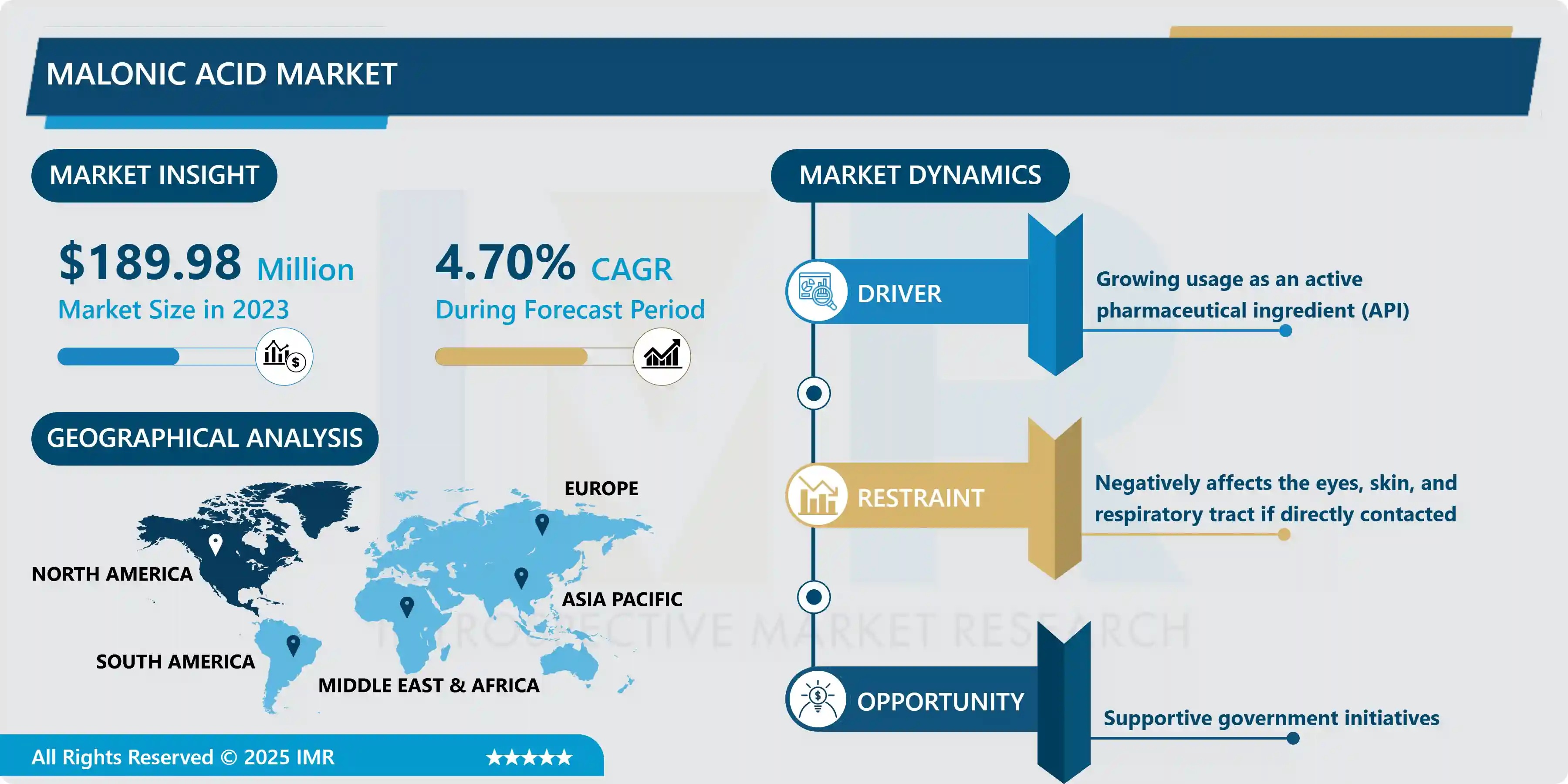
The Global Malonic Acid Market Size according to Introspective Market Research was valued at USD 189.98 million in 2023 and is projected to grow to USD 287.23 million by 2032, reflecting a compound annual growth rate (CAGR) of ~ 4.70% over the forecast period.
This growth is driven by rising demand from pharmaceutical intermediates, increasing use in specialty polymers, coatings and resins, expansion of flavor & fragrance and food-ingredient applications, and a growing shift toward bio-based synthesis methods as chemical industries worldwide move toward sustainable and “green-chemistry” practices.
Quick Insights
- 2023 Market Size: USD 189.98 million
- 2032 Forecast Market Size: USD 287.23 million
- Forecast CAGR (2024–2032): ~ 4.70%
- Top Application Segment: Pharmaceuticals (as API/intermediate) — driven by demand for vitamins, drug synthesis, and specialty APIs.
- Leading End-use Industries: Pharmaceuticals, Specialty Polymers/Resins, Coatings & Paints, Food & Flavor & Fragrance, and Emerging Green-Material Applications.
- Notable Key Players: Lonza, Trace Zero LLC, Lianyungang Huasheng Chemical, Lygos, Silworld Chemicals, Shanghai Nanxiang Reagent Co. Ltd. among others.
Market Snapshot: Revenue Forecast
|
Year |
Global Malonic Acid Market Size (USD Million) |
|
2023 |
189.98 |
|
2032 (Forecast) |
287.23 |
What’s Driving Market Growth?
IMR’s research identifies several major growth drivers for the Malonic Acid market:
- Rising Pharmaceutical Demand: Malonic Acid serves as a critical intermediate (API precursor) in the synthesis of various therapeutic molecules including vitamins, certain drugs and specialty APIs. As global healthcare demand and drug manufacturing expand, so does the need for high-purity malonic acid.
- Growth in Specialty Polymers & Sustainable Materials: Malonic acid is used in producing specialty polyesters, resins, coatings, and specialty polymers. The growing push toward biodegradable plastics and sustainable materials has renewed interest in malonic-acid–derived chemistries.
- Increase in Coatings, Adhesives & Industrial Chemicals: Demand in paints & coatings, industrial resins, adhesives and other chemical industries contributes to consistent volume demand, especially with rising infrastructure and manufacturing worldwide.
- Advances in Green-Chemistry & Bio-Based Production Routes: Some producers are investing in bio-based or less carbon-intensive routes for malonic acid, aligning with sustainability trends and regulatory encouragement for green chemicals — supporting long-term growth potential.
What Opportunities and Trends Are Emerging?
Could malonic acid become a cornerstone of sustainable polymer and specialty chemical supply chains?
As regulators, consumers, and industries increasingly demand sustainable materials, malonic acid’s role in biodegradable polyesters, green resins, and eco-friendly coatings positions it as a strategic chemical intermediate for the next generation of materials. Companies investing in green-chemistry processes or bio-based production are well placed to supply this evolving demand.
Is pharmaceutical-grade malonic acid the next growth frontier?
With rising global demand for high-purity APIs, vitamins, and specialty drugs, pharmaceutical-grade malonic acid (meeting stringent purity standards) is becoming more critical. This shift opens new high-margin opportunities for producers capable of maintaining quality, compliance and scaling supply.
Expert Commentary
“Malonic acid is quietly re-emerging as a versatile, strategic building block — not only for traditional pharmaceuticals but also for modern, sustainable materials,” said Dr. Aarav Mehta, Principal Consultant, Introspective Market Research. “As regulatory, environmental and performance pressures converge, firms that can deliver high-purity, sustainably produced malonic acid — and combine that with flexibility in polymer or API supply chains — will define the next wave of growth. In essence, malonic acid is moving from being an industrial commodity to a value-added specialty input.”
Regional & Segmentation Analysis
- Asia-Pacific: Leading region in terms of demand growth, driven by expanding pharmaceutical manufacturing, increasing industrial output, and rising adoption of specialty polymers — particularly in China, India, and Southeast Asia.
- North America & Europe: Continue to consume significant volumes, especially for pharmaceutical-grade and specialty chemical applications, supported by advanced regulatory frameworks, high-purity demand, and diversified application industries.
- By Function:
- Precursor: ~ 40% — used in specialty chemicals, agrochemicals, intermediate synthesis.
- API / Pharmaceutical Intermediate: ~ 30% — for drugs, vitamins and medicinal compounds.
- Additive: ~ 20% — used in resins, coatings, plastic modification, stabilizers.
- Other Uses: ~ 10% — niche applications including food & flavor, small-scale specialty products.
- By End-User Industry: Pharmaceuticals, Polymers & Plastics, Paints & Coatings, Food & Flavor/Fragrance, Electronics, Others — with polymers/coatings and pharma emerging as key growth engines.
Industry Breakthroughs & Key Developments
- Several chemical manufacturers, including those with advanced fine-chemical capabilities, are investing in bio-based and fermentation-derived malonic acid routes- reducing reliance on petrochemical feedstocks and aligning with global sustainability and regulatory trends.
- Increased use of malonic-acid–derived specialty polyesters and resins in biodegradable plastics, sustainable packaging, and eco-friendly coatings-responding to environmental regulations and rising demand for green materials.
- Growing demand from the pharmaceutical industry for high-purity API-grade malonic acid to support complex drug synthesis, vitamins, and specialty medications -leading manufacturers to up their quality controls and invest in high-purity chemical processing.
Cost Pressures & How to Make It Cost-Efficient — Benefits for Stakeholders
While demand is strong, the malonic acid market faces certain cost and supply-chain challenges:
- Raw-material and feedstock volatility — production often depends on petrochemical-derived precursors; fluctuations in raw material cost can impact production margins.
- Purity & processing costs for pharmaceutical-grade acid — achieving high-purity standards (for APIs and fine chemicals) demands advanced processing, quality controls, and compliance expenditures.
- Regulatory and environmental compliance burdens — especially for bio-based or green-chemistry manufacturing processes.
Strategic Levers for Cost-Efficiency & Value:
- Adopting bio-based synthesis or fermentation methods: Reduces reliance on volatile petrochemical feedstocks and aligns with sustainability mandates.
- Vertical integration & backward integration: Securing raw-material supply, intermediate feedstock procurement, and integrated processing reduces input dependency and cost variability.
- Scale-up & optimized process engineering: Larger batch production, improved yield, waste minimization and energy-efficient processing lower per-unit costs.
- Value-added specialization (high-purity, pharma-grade, green-certified): Targeting premium markets (pharma, specialty polymers, biotech) commands better margins than commodity-grade sales.
- Long-term supply agreements with end-use industries: Securing consistent off-take contracts with pharmaceutical and polymer customers ensures demand stability and justifies capital investment.
These strategies can help producers and suppliers capitalize on growing demand while preserving margins — creating sustainable, long-term value for stakeholders.
Why This Matters
Malonic acid sits at a unique crossroads — it is a foundational chemical intermediate essential for pharmaceuticals, specialty chemicals, sustainable polymers, coatings, flavoring, and more. As markets globally push toward sustainability, high-performance materials, and robust drug manufacturing cycles, malonic acid’s versatility makes it a strategic backbone for multiple industry verticals.
For chemical manufacturers, polymer producers, pharmaceutical firms, and investors — this market presents a compelling, diversified growth opportunity. Companies that proactively invest in high-purity production, green-chemistry processes, scale-up capabilities, and strong supply-chain integration are likely to emerge as leaders in the evolving malonic acid landscape over the next decade.
Download & Connect
To access our full Malonic Acid Market Report — including detailed segment-wise forecasts, regional demand analysis, capacity maps, competitive landscape, sustainability & green-chemistry insights — please Download Sample
About Introspective Market Research
Introspective Market Research (IMR) is a global market-intelligence firm specializing in specialty chemicals, fine chemicals, pharmaceuticals, materials science, and emerging industrial markets. Our senior analysts deliver deep-dive research, quantitative forecasts, competitive mapping, and strategic advisory — helping clients navigate complex value chains, identify growth levers, and build data-backed growth strategies.
Contact:
Introspective Market Research
Phone: +91-91753-37569.
Email: info@introspectivemarketresearch.com

 English
 French
 Spanish
 Portuguese
 Deutsch
 Turkish
 Dutch
Dutch
 Italiano
 Russian
 Romaian
 Portuguese (Brazil)
 Greek
Greek