


-
3 المنشورات
-
1 الصور
-
0 الفيديوهات
-
Male
-
متابَع بواسطة 0 أشخاص
البحث

 English
 French
 Spanish
 Portuguese
 Deutsch
 Turkish
 Dutch
Dutch
 Italiano
 Russian
 Romaian
 Portuguese (Brazil)
 Greek
Greek
التحديثات الأخيرة
-
# Why Website Redesigns Tank Organic Traffic for Dallas Businesses (And How to Recover)
Investing in a sleek, modern website redesign is a major milestone. However, many North Texas companies experience a baffling paradox post-launch: the new site looks beautiful, but organic traffic, local map rankings, and inbound leads plummet.
Aesthetics do not drive revenue if search engine bots cannot navigate the underlying code. When a redesign triggers a traffic cliff, it is rarely a creative failure—it is a structural breakdown caused by a flawed website migration strategy.
---
## 3 Critical Infrastructure Flaws in Website Migrations
When web development teams prioritize visuals over technical SEO, three critical errors frequently destroy accumulated search equity:
* **Broken 301 Redirect Mapping (The 404 Catastrophe):** Changing a URL path (e.g., from `/dallas-services` to `/services/dallas`) without implementing a permanent 301 redirect cuts off external backlinks and citation signals. The old links return a `404 Not Found` error, causing pages to drop out of search results completely.
* **Stripped Metadata & Semantic Data:** During content migration, optimized header structures (`H1`–`H3`), customized meta tags, and essential **JSON-LD Local Business Schema** are often dropped. Without this explicit data, algorithms lose the regional and contextual mapping of the business.
* **Indexed Staging Environments:** If a developer forgets to block search bots from crawling the test site (e.g., `staging.yourdomain.com`), Google indexes both versions. This triggers an immediate duplicate content penalty, splitting the domain's ranking authority in half.
---
## The Forensic Diagnostic Toolkit
To pinpoint exactly where the infrastructure broke post-launch, deploy these specific auditing utilities:
| Tool Name | Forensic Focus | Key Target Metric |
| --- | --- | --- |
| **Google Search Console** | Indexation Health | Crawl anomalies, hidden 404 spikes, sitemap flags |
| **Screaming Frog** | Localized Crawler | Locating broken internal link chains, missing meta headers |
| **Google Rich Results Test** | Schema Validation | Verifying structural code integrity and geo-coordinates |
---
## The 4-Step Restoration Protocol
If a website has already suffered a post-migration traffic drop, use this protocol to reverse the damage:
1. **Identify 404 Spikes:** Review the Google Search Console *Indexing* report to find dead URLs that used to drive traffic.
2. **Deploy 1-to-1 Redirects:** Map every broken legacy URL to its closest active equivalent on the new site using permanent server-level 301 redirects.
3. **Restore Semantic Data:** Compare cached versions of the old site to ensure all target headings, local copy, and JSON-LD schema have been fully ported over.
4. **Re-submit the Clean XML Sitemap:** Force an immediate search engine recrawl by submitting a sanitized sitemap directly to GSC.
---
## Prioritizing Structure Over Aesthetics
A successful web overhaul requires a perfect balance of design and technical execution. Correcting architectural infrastructure, sanitizing crawl budget waste, and securing clean server-level redirection ensures a digital transition accelerates growth rather than derailing it.
The web engineering team at **DFW Website SEO** has documented the specific technical flaws that commonly undermine local web portals. Explore their complete manual to systematically restore site health and protect your digital investments:
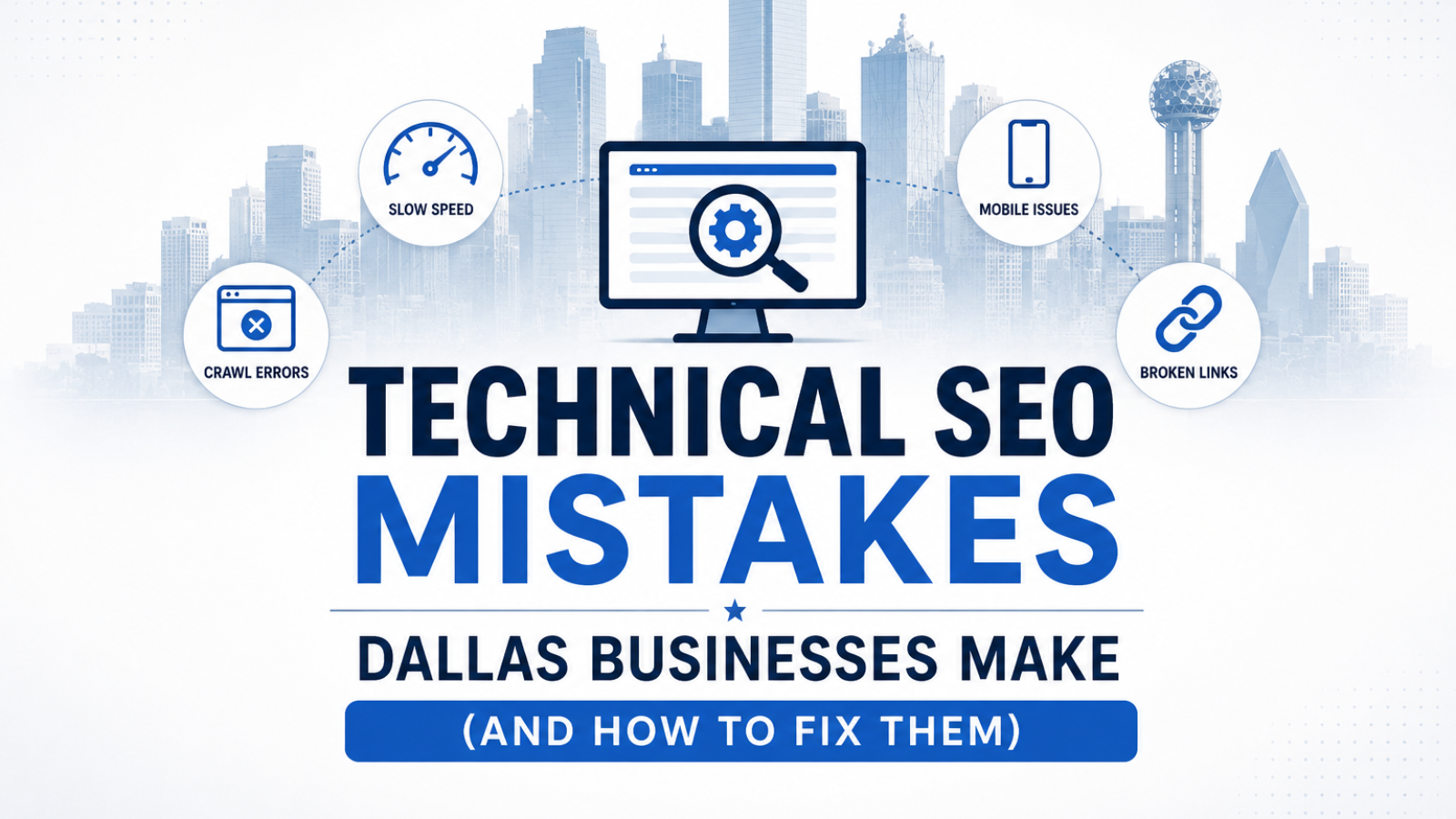
**Read the comprehensive technical guide:** [Technical SEO Mistakes Dallas Businesses Make (And How to Fix Them)](http://dfwwebsiteseo.com/technical-seo-mistakes-dallas-businesses-make-and-how-to-fix-them/)# Why Website Redesigns Tank Organic Traffic for Dallas Businesses (And How to Recover) Investing in a sleek, modern website redesign is a major milestone. However, many North Texas companies experience a baffling paradox post-launch: the new site looks beautiful, but organic traffic, local map rankings, and inbound leads plummet. Aesthetics do not drive revenue if search engine bots cannot navigate the underlying code. When a redesign triggers a traffic cliff, it is rarely a creative failure—it is a structural breakdown caused by a flawed website migration strategy. --- ## 3 Critical Infrastructure Flaws in Website Migrations When web development teams prioritize visuals over technical SEO, three critical errors frequently destroy accumulated search equity: * **Broken 301 Redirect Mapping (The 404 Catastrophe):** Changing a URL path (e.g., from `/dallas-services` to `/services/dallas`) without implementing a permanent 301 redirect cuts off external backlinks and citation signals. The old links return a `404 Not Found` error, causing pages to drop out of search results completely. * **Stripped Metadata & Semantic Data:** During content migration, optimized header structures (`H1`–`H3`), customized meta tags, and essential **JSON-LD Local Business Schema** are often dropped. Without this explicit data, algorithms lose the regional and contextual mapping of the business. * **Indexed Staging Environments:** If a developer forgets to block search bots from crawling the test site (e.g., `staging.yourdomain.com`), Google indexes both versions. This triggers an immediate duplicate content penalty, splitting the domain's ranking authority in half. --- ## The Forensic Diagnostic Toolkit To pinpoint exactly where the infrastructure broke post-launch, deploy these specific auditing utilities: | Tool Name | Forensic Focus | Key Target Metric | | --- | --- | --- | | **Google Search Console** | Indexation Health | Crawl anomalies, hidden 404 spikes, sitemap flags | | **Screaming Frog** | Localized Crawler | Locating broken internal link chains, missing meta headers | | **Google Rich Results Test** | Schema Validation | Verifying structural code integrity and geo-coordinates | --- ## The 4-Step Restoration Protocol If a website has already suffered a post-migration traffic drop, use this protocol to reverse the damage: 1. **Identify 404 Spikes:** Review the Google Search Console *Indexing* report to find dead URLs that used to drive traffic. 2. **Deploy 1-to-1 Redirects:** Map every broken legacy URL to its closest active equivalent on the new site using permanent server-level 301 redirects. 3. **Restore Semantic Data:** Compare cached versions of the old site to ensure all target headings, local copy, and JSON-LD schema have been fully ported over. 4. **Re-submit the Clean XML Sitemap:** Force an immediate search engine recrawl by submitting a sanitized sitemap directly to GSC. --- ## Prioritizing Structure Over Aesthetics A successful web overhaul requires a perfect balance of design and technical execution. Correcting architectural infrastructure, sanitizing crawl budget waste, and securing clean server-level redirection ensures a digital transition accelerates growth rather than derailing it. The web engineering team at **DFW Website SEO** has documented the specific technical flaws that commonly undermine local web portals. Explore their complete manual to systematically restore site health and protect your digital investments: 👉 **Read the comprehensive technical guide:** [Technical SEO Mistakes Dallas Businesses Make (And How to Fix Them)](http://dfwwebsiteseo.com/technical-seo-mistakes-dallas-businesses-make-and-how-to-fix-them/)0 التعليقات 0 المشاركات 956 مشاهدة 0 معاينة -
Future-Proofing Dallas B2B: Web Design Strategy for the AI Search Era
In the fast-paced Dallas-Fort Worth business environment, how enterprise buyers find potential partners is undergoing a seismic shift. For years, the goal of B2B SEO was simply to rank in Google’s top ten blue links. Today, with the rapid adoption of generative AI—including ChatGPT, Gemini, and Google’s AI Overviews (formerly SGE)—the search engine is evolving into an "answer engine."
For DFW executives looking to secure contracts, this means your digital presence faces a new challenge. It’s no longer enough for your website to be visually appealing to humans; it must be structured in a way that AI algorithms can understand, trust, and summarize. If your DFW web design isn't optimized for this new reality, your business risks being excluded from the AI-generated snapshots that busy decision-makers increasingly rely on.
At DFW Website SEO, we are pioneering AI-ready web architecture for B2B clients. Here is how the landscape has changed and what your business needs to do to remain visible.1. The Shift from "Keywords" to "Entities" in B2B Search
Traditional B2B SEO focused heavily on specific keyword phrases (e.g., "managed IT services Dallas"). While keywords still matter, AI search models think in terms of "entities"—concepts, businesses, locations, and the relationships between them.
When a procurement officer in Plano asks an AI, "Who are the most reliable commercial construction firms in North Texas for healthcare facilities?", the AI doesn't just match keywords. It looks for entities that have established authority in that specific niche and location.
A generic, template-based website often fails to establish these entity relationships clearly. A strategic Dallas web design agency must build a site architecture that clearly defines who you are, where you operate (DFW metroplex), and what specific B2B problems you solve, using language that AI models recognize as authoritative.2. The Critical Role of Structured Data (Schema Markup)
If content is what you say to human visitors, structured data (schema markup) is what you say to AI robots. It is the hidden code that translates your website’s content into a format that machines can process instantly.
To increase the chances of your B2B company appearing in AI Overviews or featured snippets, your web designer in Dallas TX must implement advanced schema strategies. This goes beyond basic contact info. B2B sites require specialized markup:
Organization & LocalBusiness Schema: Clearly defining your headquarters, service areas within DFW, and corporate identity.
Service Schema: Detailed markup explaining your specific B2B offerings (e.g., "Supply Chain Consulting," "Industrial HVAC Repair") to help AI match you to specific technical queries.
FAQPage Schema: Formatting common B2B objections and technical questions in a way that AI can directly extract and present as an answer to a user's question.
Without this technical foundation, AI crawlers have to guess what your business does—and in the high-stakes B2B market, guessing leads to exclusion.3. Developing Topical Authority Clusters
AI models prioritize depth and breadth of knowledge. A five-page brochure website is insufficient for establishing expertise in complex B2B sectors like finance, logistics, or manufacturing.
To signal authority to AI, your DFW web design must be supported by a "hub and spoke" content strategy. This involves creating a central, comprehensive service page (the hub) linked to dozens of detailed supporting articles (the spokes) that answer every conceivable aspect of that service related to the Dallas market.
For example, rather than one generic page about "Commercial Roofing," an authoritative DFW site would have auxiliary content covering "Dallas commercial roofing codes," "impact resistance standards for North Texas hail," and "TPO vs. EPDM for Dallas warehouses." This level of topical depth signals to Google's AI that you are the definitive source on the subject in this region.
Conclusion: Adapt Your Digital Infrastructure Today
The B2B buying journey in Dallas is becoming AI-assisted. Executives are using these tools to create vendor shortlists faster than ever before. Your website needs to be engineered to make that shortlist.
Stop relying on outdated SEO tactics. Invest in a custom web design in Dallas that prioritizes technical structure, schema implementation, and deep topical authority.
Is your current website invisible to AI search?
SEO Meta Description: B2B vendor selection in Dallas is shifting to AI search. Learn how your DFW web design must use structured data and entity awareness to rank in AI Overviews.
https://dfwwebsiteseo.com/website-design/Future-Proofing Dallas B2B: Web Design Strategy for the AI Search Era In the fast-paced Dallas-Fort Worth business environment, how enterprise buyers find potential partners is undergoing a seismic shift. For years, the goal of B2B SEO was simply to rank in Google’s top ten blue links. Today, with the rapid adoption of generative AI—including ChatGPT, Gemini, and Google’s AI Overviews (formerly SGE)—the search engine is evolving into an "answer engine." For DFW executives looking to secure contracts, this means your digital presence faces a new challenge. It’s no longer enough for your website to be visually appealing to humans; it must be structured in a way that AI algorithms can understand, trust, and summarize. If your DFW web design isn't optimized for this new reality, your business risks being excluded from the AI-generated snapshots that busy decision-makers increasingly rely on. At DFW Website SEO, we are pioneering AI-ready web architecture for B2B clients. Here is how the landscape has changed and what your business needs to do to remain visible.1. The Shift from "Keywords" to "Entities" in B2B Search Traditional B2B SEO focused heavily on specific keyword phrases (e.g., "managed IT services Dallas"). While keywords still matter, AI search models think in terms of "entities"—concepts, businesses, locations, and the relationships between them. When a procurement officer in Plano asks an AI, "Who are the most reliable commercial construction firms in North Texas for healthcare facilities?", the AI doesn't just match keywords. It looks for entities that have established authority in that specific niche and location. A generic, template-based website often fails to establish these entity relationships clearly. A strategic Dallas web design agency must build a site architecture that clearly defines who you are, where you operate (DFW metroplex), and what specific B2B problems you solve, using language that AI models recognize as authoritative.2. The Critical Role of Structured Data (Schema Markup) If content is what you say to human visitors, structured data (schema markup) is what you say to AI robots. It is the hidden code that translates your website’s content into a format that machines can process instantly. To increase the chances of your B2B company appearing in AI Overviews or featured snippets, your web designer in Dallas TX must implement advanced schema strategies. This goes beyond basic contact info. B2B sites require specialized markup: Organization & LocalBusiness Schema: Clearly defining your headquarters, service areas within DFW, and corporate identity. Service Schema: Detailed markup explaining your specific B2B offerings (e.g., "Supply Chain Consulting," "Industrial HVAC Repair") to help AI match you to specific technical queries. FAQPage Schema: Formatting common B2B objections and technical questions in a way that AI can directly extract and present as an answer to a user's question. Without this technical foundation, AI crawlers have to guess what your business does—and in the high-stakes B2B market, guessing leads to exclusion.3. Developing Topical Authority Clusters AI models prioritize depth and breadth of knowledge. A five-page brochure website is insufficient for establishing expertise in complex B2B sectors like finance, logistics, or manufacturing. To signal authority to AI, your DFW web design must be supported by a "hub and spoke" content strategy. This involves creating a central, comprehensive service page (the hub) linked to dozens of detailed supporting articles (the spokes) that answer every conceivable aspect of that service related to the Dallas market. For example, rather than one generic page about "Commercial Roofing," an authoritative DFW site would have auxiliary content covering "Dallas commercial roofing codes," "impact resistance standards for North Texas hail," and "TPO vs. EPDM for Dallas warehouses." This level of topical depth signals to Google's AI that you are the definitive source on the subject in this region. Conclusion: Adapt Your Digital Infrastructure Today The B2B buying journey in Dallas is becoming AI-assisted. Executives are using these tools to create vendor shortlists faster than ever before. Your website needs to be engineered to make that shortlist. Stop relying on outdated SEO tactics. Invest in a custom web design in Dallas that prioritizes technical structure, schema implementation, and deep topical authority. Is your current website invisible to AI search? SEO Meta Description: B2B vendor selection in Dallas is shifting to AI search. Learn how your DFW web design must use structured data and entity awareness to rank in AI Overviews. https://dfwwebsiteseo.com/website-design/0 التعليقات 0 المشاركات 754 مشاهدة 0 معاينة

المزيد من المنشورات