


# Why Website Redesigns Tank Organic Traffic for Dallas Businesses (And How to Recover)
Investing in a sleek, modern website redesign is a major milestone. However, many North Texas companies experience a baffling paradox post-launch: the new site looks beautiful, but organic traffic, local map rankings, and inbound leads plummet.
Aesthetics do not drive revenue if search engine bots cannot navigate the underlying code. When a redesign triggers a traffic cliff, it is rarely a creative failure—it is a structural breakdown caused by a flawed website migration strategy.
---
## 3 Critical Infrastructure Flaws in Website Migrations
When web development teams prioritize visuals over technical SEO, three critical errors frequently destroy accumulated search equity:
* **Broken 301 Redirect Mapping (The 404 Catastrophe):** Changing a URL path (e.g., from `/dallas-services` to `/services/dallas`) without implementing a permanent 301 redirect cuts off external backlinks and citation signals. The old links return a `404 Not Found` error, causing pages to drop out of search results completely.
* **Stripped Metadata & Semantic Data:** During content migration, optimized header structures (`H1`–`H3`), customized meta tags, and essential **JSON-LD Local Business Schema** are often dropped. Without this explicit data, algorithms lose the regional and contextual mapping of the business.
* **Indexed Staging Environments:** If a developer forgets to block search bots from crawling the test site (e.g., `staging.yourdomain.com`), Google indexes both versions. This triggers an immediate duplicate content penalty, splitting the domain's ranking authority in half.
---
## The Forensic Diagnostic Toolkit
To pinpoint exactly where the infrastructure broke post-launch, deploy these specific auditing utilities:
| Tool Name | Forensic Focus | Key Target Metric |
| --- | --- | --- |
| **Google Search Console** | Indexation Health | Crawl anomalies, hidden 404 spikes, sitemap flags |
| **Screaming Frog** | Localized Crawler | Locating broken internal link chains, missing meta headers |
| **Google Rich Results Test** | Schema Validation | Verifying structural code integrity and geo-coordinates |
---
## The 4-Step Restoration Protocol
If a website has already suffered a post-migration traffic drop, use this protocol to reverse the damage:
1. **Identify 404 Spikes:** Review the Google Search Console *Indexing* report to find dead URLs that used to drive traffic.
2. **Deploy 1-to-1 Redirects:** Map every broken legacy URL to its closest active equivalent on the new site using permanent server-level 301 redirects.
3. **Restore Semantic Data:** Compare cached versions of the old site to ensure all target headings, local copy, and JSON-LD schema have been fully ported over.
4. **Re-submit the Clean XML Sitemap:** Force an immediate search engine recrawl by submitting a sanitized sitemap directly to GSC.
---
## Prioritizing Structure Over Aesthetics
A successful web overhaul requires a perfect balance of design and technical execution. Correcting architectural infrastructure, sanitizing crawl budget waste, and securing clean server-level redirection ensures a digital transition accelerates growth rather than derailing it.
The web engineering team at **DFW Website SEO** has documented the specific technical flaws that commonly undermine local web portals. Explore their complete manual to systematically restore site health and protect your digital investments:
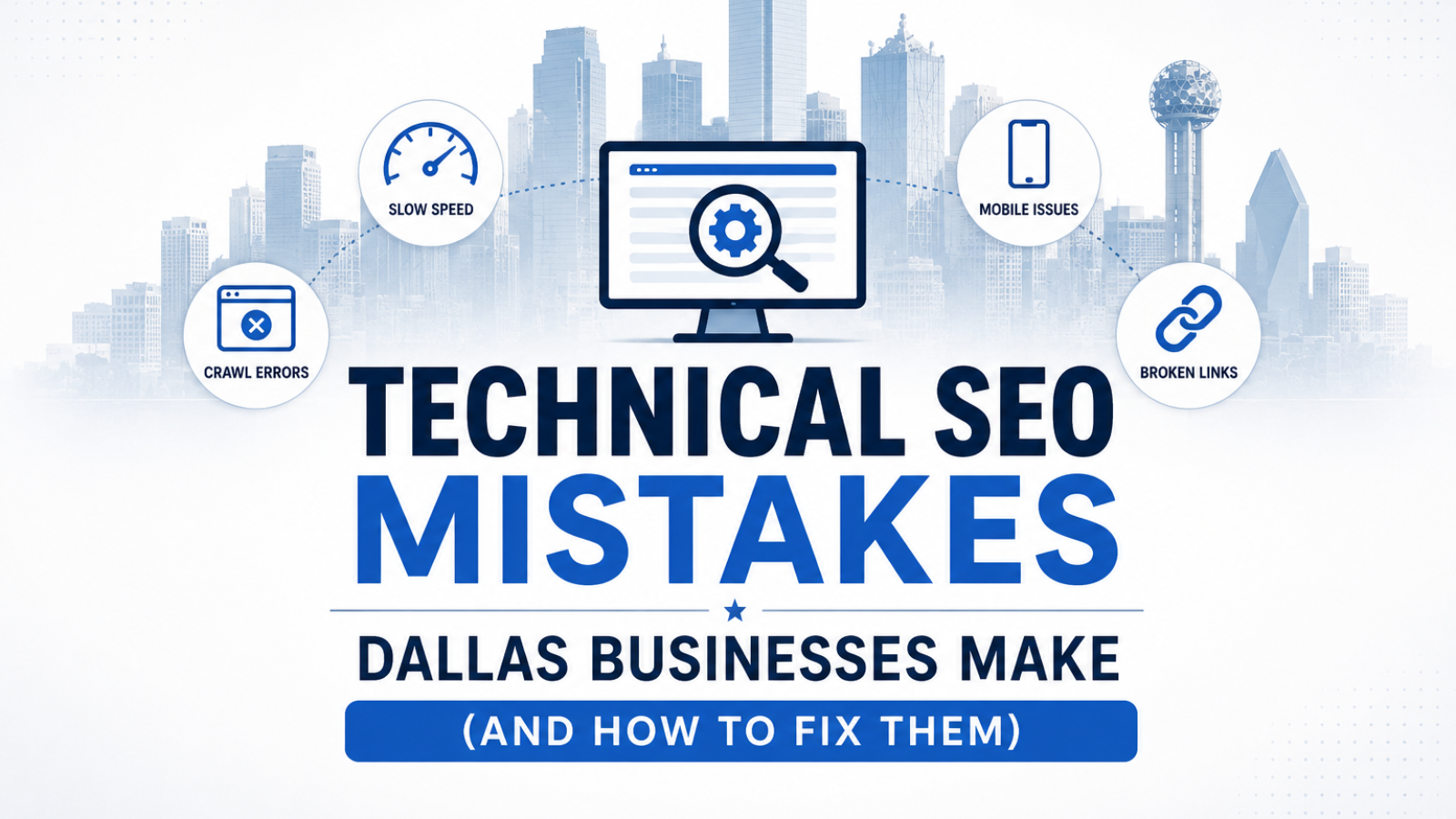
**Read the comprehensive technical guide:** [Technical SEO Mistakes Dallas Businesses Make (And How to Fix Them)](http://dfwwebsiteseo.com/technical-seo-mistakes-dallas-businesses-make-and-how-to-fix-them/)
Investing in a sleek, modern website redesign is a major milestone. However, many North Texas companies experience a baffling paradox post-launch: the new site looks beautiful, but organic traffic, local map rankings, and inbound leads plummet.
Aesthetics do not drive revenue if search engine bots cannot navigate the underlying code. When a redesign triggers a traffic cliff, it is rarely a creative failure—it is a structural breakdown caused by a flawed website migration strategy.
---
## 3 Critical Infrastructure Flaws in Website Migrations
When web development teams prioritize visuals over technical SEO, three critical errors frequently destroy accumulated search equity:
* **Broken 301 Redirect Mapping (The 404 Catastrophe):** Changing a URL path (e.g., from `/dallas-services` to `/services/dallas`) without implementing a permanent 301 redirect cuts off external backlinks and citation signals. The old links return a `404 Not Found` error, causing pages to drop out of search results completely.
* **Stripped Metadata & Semantic Data:** During content migration, optimized header structures (`H1`–`H3`), customized meta tags, and essential **JSON-LD Local Business Schema** are often dropped. Without this explicit data, algorithms lose the regional and contextual mapping of the business.
* **Indexed Staging Environments:** If a developer forgets to block search bots from crawling the test site (e.g., `staging.yourdomain.com`), Google indexes both versions. This triggers an immediate duplicate content penalty, splitting the domain's ranking authority in half.
---
## The Forensic Diagnostic Toolkit
To pinpoint exactly where the infrastructure broke post-launch, deploy these specific auditing utilities:
| Tool Name | Forensic Focus | Key Target Metric |
| --- | --- | --- |
| **Google Search Console** | Indexation Health | Crawl anomalies, hidden 404 spikes, sitemap flags |
| **Screaming Frog** | Localized Crawler | Locating broken internal link chains, missing meta headers |
| **Google Rich Results Test** | Schema Validation | Verifying structural code integrity and geo-coordinates |
---
## The 4-Step Restoration Protocol
If a website has already suffered a post-migration traffic drop, use this protocol to reverse the damage:
1. **Identify 404 Spikes:** Review the Google Search Console *Indexing* report to find dead URLs that used to drive traffic.
2. **Deploy 1-to-1 Redirects:** Map every broken legacy URL to its closest active equivalent on the new site using permanent server-level 301 redirects.
3. **Restore Semantic Data:** Compare cached versions of the old site to ensure all target headings, local copy, and JSON-LD schema have been fully ported over.
4. **Re-submit the Clean XML Sitemap:** Force an immediate search engine recrawl by submitting a sanitized sitemap directly to GSC.
---
## Prioritizing Structure Over Aesthetics
A successful web overhaul requires a perfect balance of design and technical execution. Correcting architectural infrastructure, sanitizing crawl budget waste, and securing clean server-level redirection ensures a digital transition accelerates growth rather than derailing it.
The web engineering team at **DFW Website SEO** has documented the specific technical flaws that commonly undermine local web portals. Explore their complete manual to systematically restore site health and protect your digital investments:
**Read the comprehensive technical guide:** [Technical SEO Mistakes Dallas Businesses Make (And How to Fix Them)](http://dfwwebsiteseo.com/technical-seo-mistakes-dallas-businesses-make-and-how-to-fix-them/)
# Why Website Redesigns Tank Organic Traffic for Dallas Businesses (And How to Recover)
Investing in a sleek, modern website redesign is a major milestone. However, many North Texas companies experience a baffling paradox post-launch: the new site looks beautiful, but organic traffic, local map rankings, and inbound leads plummet.
Aesthetics do not drive revenue if search engine bots cannot navigate the underlying code. When a redesign triggers a traffic cliff, it is rarely a creative failure—it is a structural breakdown caused by a flawed website migration strategy.
---
## 3 Critical Infrastructure Flaws in Website Migrations
When web development teams prioritize visuals over technical SEO, three critical errors frequently destroy accumulated search equity:
* **Broken 301 Redirect Mapping (The 404 Catastrophe):** Changing a URL path (e.g., from `/dallas-services` to `/services/dallas`) without implementing a permanent 301 redirect cuts off external backlinks and citation signals. The old links return a `404 Not Found` error, causing pages to drop out of search results completely.
* **Stripped Metadata & Semantic Data:** During content migration, optimized header structures (`H1`–`H3`), customized meta tags, and essential **JSON-LD Local Business Schema** are often dropped. Without this explicit data, algorithms lose the regional and contextual mapping of the business.
* **Indexed Staging Environments:** If a developer forgets to block search bots from crawling the test site (e.g., `staging.yourdomain.com`), Google indexes both versions. This triggers an immediate duplicate content penalty, splitting the domain's ranking authority in half.
---
## The Forensic Diagnostic Toolkit
To pinpoint exactly where the infrastructure broke post-launch, deploy these specific auditing utilities:
| Tool Name | Forensic Focus | Key Target Metric |
| --- | --- | --- |
| **Google Search Console** | Indexation Health | Crawl anomalies, hidden 404 spikes, sitemap flags |
| **Screaming Frog** | Localized Crawler | Locating broken internal link chains, missing meta headers |
| **Google Rich Results Test** | Schema Validation | Verifying structural code integrity and geo-coordinates |
---
## The 4-Step Restoration Protocol
If a website has already suffered a post-migration traffic drop, use this protocol to reverse the damage:
1. **Identify 404 Spikes:** Review the Google Search Console *Indexing* report to find dead URLs that used to drive traffic.
2. **Deploy 1-to-1 Redirects:** Map every broken legacy URL to its closest active equivalent on the new site using permanent server-level 301 redirects.
3. **Restore Semantic Data:** Compare cached versions of the old site to ensure all target headings, local copy, and JSON-LD schema have been fully ported over.
4. **Re-submit the Clean XML Sitemap:** Force an immediate search engine recrawl by submitting a sanitized sitemap directly to GSC.
---
## Prioritizing Structure Over Aesthetics
A successful web overhaul requires a perfect balance of design and technical execution. Correcting architectural infrastructure, sanitizing crawl budget waste, and securing clean server-level redirection ensures a digital transition accelerates growth rather than derailing it.
The web engineering team at **DFW Website SEO** has documented the specific technical flaws that commonly undermine local web portals. Explore their complete manual to systematically restore site health and protect your digital investments:
👉 **Read the comprehensive technical guide:** [Technical SEO Mistakes Dallas Businesses Make (And How to Fix Them)](http://dfwwebsiteseo.com/technical-seo-mistakes-dallas-businesses-make-and-how-to-fix-them/)
0 Reacties
0 aandelen
955 Views
0 voorbeeld

 English
 Arabic
 French
 Spanish
 Portuguese
 Deutsch
 Turkish
 Italiano
 Russian
 Romaian
 Portuguese (Brazil)
 Greek
Greek